Thursday, May 31, 2012

Transplanting Cranberries

Last fall while picking wild cranberries I also brought several plants home with me. My thought was to establish a bed of cranberries on our land . I had previously found a few plants in one small area. This pic is of one of the plants I moved last fall. The viney plant with the little leaves is the cranberry. There are two species of bog cranberry in our area, the large cranberry ,Vaccinium macrocarpon, and the small cranberry, Vaccinium oxycoccos. Commercially grown cranberries are the large cranberry and they are the same plant as the wild one. I didn't know how to tell the two of them apart last fall . Having learned more about them since then I now realize that most of my transplants are the small cranberry. I will try to find some of the large cranberry to transplant here this year. Needless to say all of the plants already growing here are also the small cranberry and I have found them in at least two other areas on our property since then. It always amazes me how once we have learned to recognized a plant it seems to be every where!

One of the tell tale signs that this is the small cranberry is the fact that the flower buds are at the end of the vine. They are the two little pink dots at the end of the vine. Large cranberry tends to have them along the sides of the vine.

Wednesday, May 30, 2012

Mud Oven In Use

With the hot weather we had this week we were encouraged to try the mud oven I built last year rather than heating the house up while baking bread. We only tried using it a couple times last year and the results were so-so. Like most things in life, baking in a mud oven takes practice. I got a little carried away building this one and made it way too big. After some practice though we are starting to figure out the operating  directions for our model. Because of it's size and mass the fire has to burn for a long time to bring it up to baking temperature.
I started the fire the evening before and banked it with a couple of biggish pieces over night. This had the oven at about 200 degrees in the morning. I added a couple more big hunks of wood and left it burn slow until early afternoon.A hour before Ann was ready to start baking I built up a big blaze with small very dry wood that burned for about 30 minutes. Then I cleaned it out and let the heat soak in. When I opened it up for Ann to put in the scones , top pic,  it was at 450 degrees. They came out and five loaves of bread went in. After the bread was done in about a hour, Ann put in potatoes to bake, they were done about an hour and a half latter. The pic of bread isn't very good, the loaves were the same beautiful golden brown as the scones. There is a previous post about the mud oven in the archives, January 2012, if you want to see more about the
oven.

Friday, May 25, 2012

Oyster Mushroom Yum-Yum

Here's our first edible mushroom this year. The Oyster mushroom, Pleurotus ostreatus, is a great mushroom. It is not only tasty ,it is also fairly common and fruits from now 'till hard frost. Most of these were a little on the old side but they still made some fine cream of mushroom soup. All of yesterdays finds were on smallish aspen trees. We found many on trees that had them on last year which is common. Remember where you find them, they will probably fruit there again this year.We pick another variety of oyster that appears to prefer maple trees and only seems to fruit in autumn. We ended up with a couple pounds of usable mushroom. We had a good hard rain last night which should start a lot of mushrooms growing in a few days. Most wild mushrooms are very good dried and it is time to replenish our supply.
We found one other edible on our walk, the Pheasant Back, Polyporus squamosus , but it was much to old and tough to eat.  As always, a word of caution, if you can not positively identify it, don't eat it.

Tuesday, May 22, 2012

Swamp Salifrage

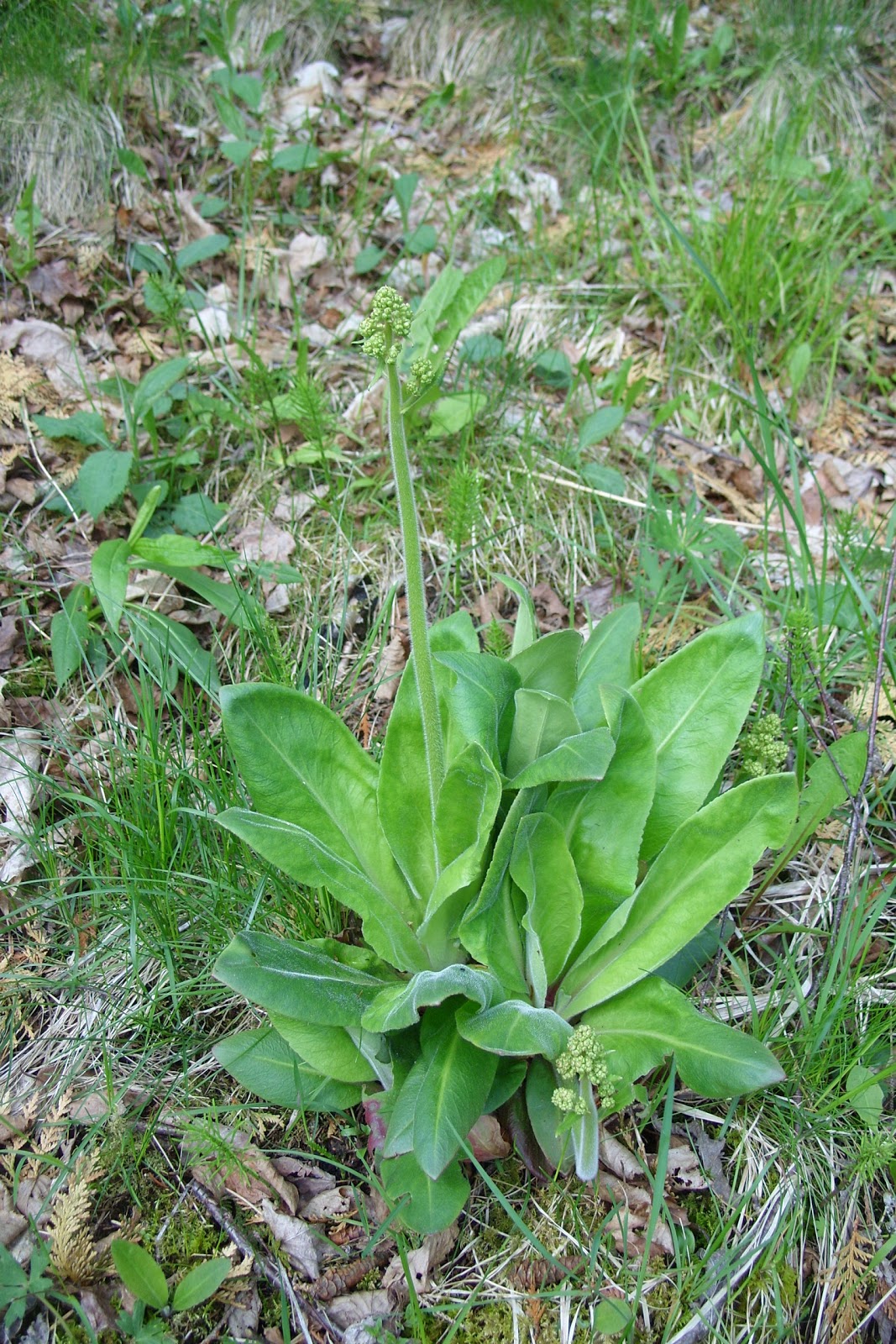
This early spring edible, Swamp Salifrage, Saxifraga pensylvanica, is found in swamps and other wet areas. I didn't know it as a edible before reading Samuel Thayer's first book, The Forager's Harvest. That is also the name on his website. While the leaves are edible with cooking I agree with Mr. Thayer that they are not very palatable. The crispy flower stalk does make a great trail side snack though.I found this one and about a dozen more along side the ditch in our local national forest. It seems to be fairly common but the flower stalk is only available in the spring of course.
The thing that always amazes me after I learn about a new plant,is that I was not even aware that it existed in many cases. My wife and I do a lot of foraging for edible and medicinal plants and we live in the woods. One would think that we would know every single plant that grew in our area but we are constantly finding things we have never seen before. Last year after hearing about a plant called winter berry we went looking for it in a area with the right type of habitat. This was about 100 feet from our cabin. We found a dozen or more winter berry plants! I am sure I had never noticed this plant before despite living here for 23 years.  Really LOOK around and you will be amazed at the diversity and abundance of the natural world.
Add caption


Winter Berry

Thursday, May 17, 2012

Delicious or Deadly

The False Morel, Gyromitra brunnea, has caused deaths in Europe yet is eaten in parts of the U.S. with no apparent bad effects. It is known that the toxin in the False Morel stays in the body and can build up to a deadly dose if enough mushrooms are eaten. It does not really resemble a true morel that much. It has wrinkles and folds rather than the pits found on morels. We found this bunch which was quite large while picking Ostrich fern last week. For my part I am not eating any mushroom that "might" kill me! As with all wild mushrooms, if you are not 100%, absolutely  positive as to the ID of a mushroom, DO NOT EAT IT. Hopefully we will find some edible mushrooms one of these days and show you some pics of them. Mean while ,Ann just told me we have more baby goats in the barn plus we brought home another calf last night  and we have baby chickens coming tomorrow. I guess I'd better get to work.

Tuesday, May 15, 2012

Alpine Doe and Kids

Our Alpine doe, Caramel, freshened Sunday. She had twins, a buck and a doe. The buck is the black and white one. The doe is solid Saneen white as was her sire. The sire came from a well known milking line so hopefully the doe inherited some of that. Caramel had her babies on her own with no problems and both kids are nursing and doing fine. We now have to decide how long to leave the kids nurse. The easiest and fastest way to socialize those kids to humans is to bottle feed them. They soon accept people as mama and usually grow up to be nice friendly goats that do not mind being handled. We have a excess of milk right now so do not need to take any of Caramel's milk for our use and it would be one more item on the daily list of chores. Caramel's pen mate, Cupcake, is due to freshen in a few days also. I guess for now we will just have to allow some time every day to play with the baby goats!

Friday, May 11, 2012

Threshing Wild Rice

It seems like a strange time to be writing about wild rice since we harvest it in August.Wild rice is versatile in that respect however and keeps just fine in the hulls as long as it is well dried.We had a lot of rice left over from the year before and were busy last fall so we stored our dry rice until now. This first pic is of Ann stirring the rice in our parching pan. Parching is the first of three steps in threshing the rice. There is a small fire below the pan and the rice is being  heated to desiccate the hull making it easier to remove. The second step is treading the rice, traditional done in a hole lined with leather. A small amount of rice was placed in the hole and then gently treadled on while wearing leather moccasins.The friction between the leather surfaces ripped the hulls loose. This process requires young men and women with stamina to tread for hours so I have resorted to the contraption in the pic at left.It works on the same basis as an old flour mill with rubber disc substituted for the stone burrs. The top 20 inch diameter rubber disc has a hole in the center allowing the grain to be fed in. As it rotates the rice is rolled between the moving top disc and the stationary bottom disc. It works fairly well but not as well as I would like. I'll have to do some tweaking on it. The third step is winnowing. This requires a good breeze or a fan. It being a calm day, you can see the rice being poured in front of the fan allowing the lighter hulls to be blown away.We save the rice hulls to use in the chickens nest boxes. The rice usually needs to be ran through my treader two or three times.