Saturday, July 14, 2012
Cheap Help
The Eastern American Toad, Bufo a. ameriacanus, is a organic gardener's true friend, eating as many as 10,000 pests, such as slugs, a season. Toads will not cause warts but they will give cats or dogs that bother them a nasty surprise. Toads secret a toxin, bufotoxin, from glands on their back just behind the eyes. While it is not usually deadly it certainly seems to get the message across and very few pets bother toads a second time. Toads will also puff up some times and will pee alot. Apparently this also taste bad to predators. Toads, which hibernate during the winter, are mostly nocturnal hunters and spend the day dug into the soil. They dig in butt first using their back feet to push dirt aside. They lay their strings of eggs in shallow water every spring. The tadpoles eat vegetation while the adults are strictly carnivorous. That's the part I like! I'll be moving a few more "guests" into my gardens whenever I spot one.. This is as cheap as help gets.
Thursday, July 12, 2012
Shocking Flax
These are shocks of flax set up to dry. This is the first step in a long process to obtain linen. We will also have seed for our next crop plus seed to use as feed or to extract oil from. Flax seed is 20% oil so that could yield a fair amount. The oil was traditionally used as a lamp oil as well as a furniture finish. The flax is pulled rather than cut in the traditional manner and then bundles are made. Each bundle is a handful and is tied with several stalks of flax as shown in the bottom pic.After there are 20-30 bundles made up they are stood, leaning against each, other to form the shock.
They will be left in these shocks to dry down. After they are dry the seed pods, each of which contain about 10 seeds, will be removed. Every plant has multiple seed pods. The pods then will be crushed and the chaff winnowed out. The bundles will then be retted to break down the "glue" that holds the fiber to the stalk. The fiber is about 10% of the stalks bulk. Removing it is a many step process that uses many specialized tools. I am in the process of building those tools now and should have some pics soon. So far I have the first tool we need done. It is
called a rippling comb and is used to remove the seed pods from the bundles of flax. I made mine with 22, 31/2 inch long nails brazed to a piece of angle iron. The nails are spaced about 1/4 inch apart. I attached it to a box to catch the seed pods. I will see if it actually works when the flax is dry. This is all learn as we go so you never know.
They will be left in these shocks to dry down. After they are dry the seed pods, each of which contain about 10 seeds, will be removed. Every plant has multiple seed pods. The pods then will be crushed and the chaff winnowed out. The bundles will then be retted to break down the "glue" that holds the fiber to the stalk. The fiber is about 10% of the stalks bulk. Removing it is a many step process that uses many specialized tools. I am in the process of building those tools now and should have some pics soon. So far I have the first tool we need done. It is
called a rippling comb and is used to remove the seed pods from the bundles of flax. I made mine with 22, 31/2 inch long nails brazed to a piece of angle iron. The nails are spaced about 1/4 inch apart. I attached it to a box to catch the seed pods. I will see if it actually works when the flax is dry. This is all learn as we go so you never know.
Sunday, July 8, 2012
Grape Vines
this winter and it was fairly mild.
Here is a pic of wild blueberries starting to ripen. Unfortunately the wild turkeys seem to enjoy them and I'm not sure how many we will get before they do.
Friday, July 6, 2012
Chicken Choices
Here are our new choices in chicken breeds. The white ones are Light Brahmas ,a heavy dual purpose breed. The reds are a meat, broiler type called Freedom Rangers. We have been trying different breeds of chickens for several years now in a effort to find the perfect breed for our farm flock.
The Freedom Rangers are a replacement for the standard White Rock-Cornish cross broilers we usually get. While those guys grow fast they need a lot of expensive grain to do it. The Freedom Rangers are a much more active bird and should do better with a least part of their diet being pasture. Time will tell.I hope to get them on pasture tomorrow
The Light Brahmas have the traits we think we need for our farm flock. Dual purpose, small comb and feathered feet for our cold winters and not so improved that they are never broody. The light part of the name refers to the color rather than the size. We put them in their chicken tractor last week. They seem to like it and really hunt for bugs and tastier bits of greens when we move them.
The Freedom Rangers are a replacement for the standard White Rock-Cornish cross broilers we usually get. While those guys grow fast they need a lot of expensive grain to do it. The Freedom Rangers are a much more active bird and should do better with a least part of their diet being pasture. Time will tell.I hope to get them on pasture tomorrow
The Light Brahmas have the traits we think we need for our farm flock. Dual purpose, small comb and feathered feet for our cold winters and not so improved that they are never broody. The light part of the name refers to the color rather than the size. We put them in their chicken tractor last week. They seem to like it and really hunt for bugs and tastier bits of greens when we move them.
Wednesday, July 4, 2012
Scouting Trip
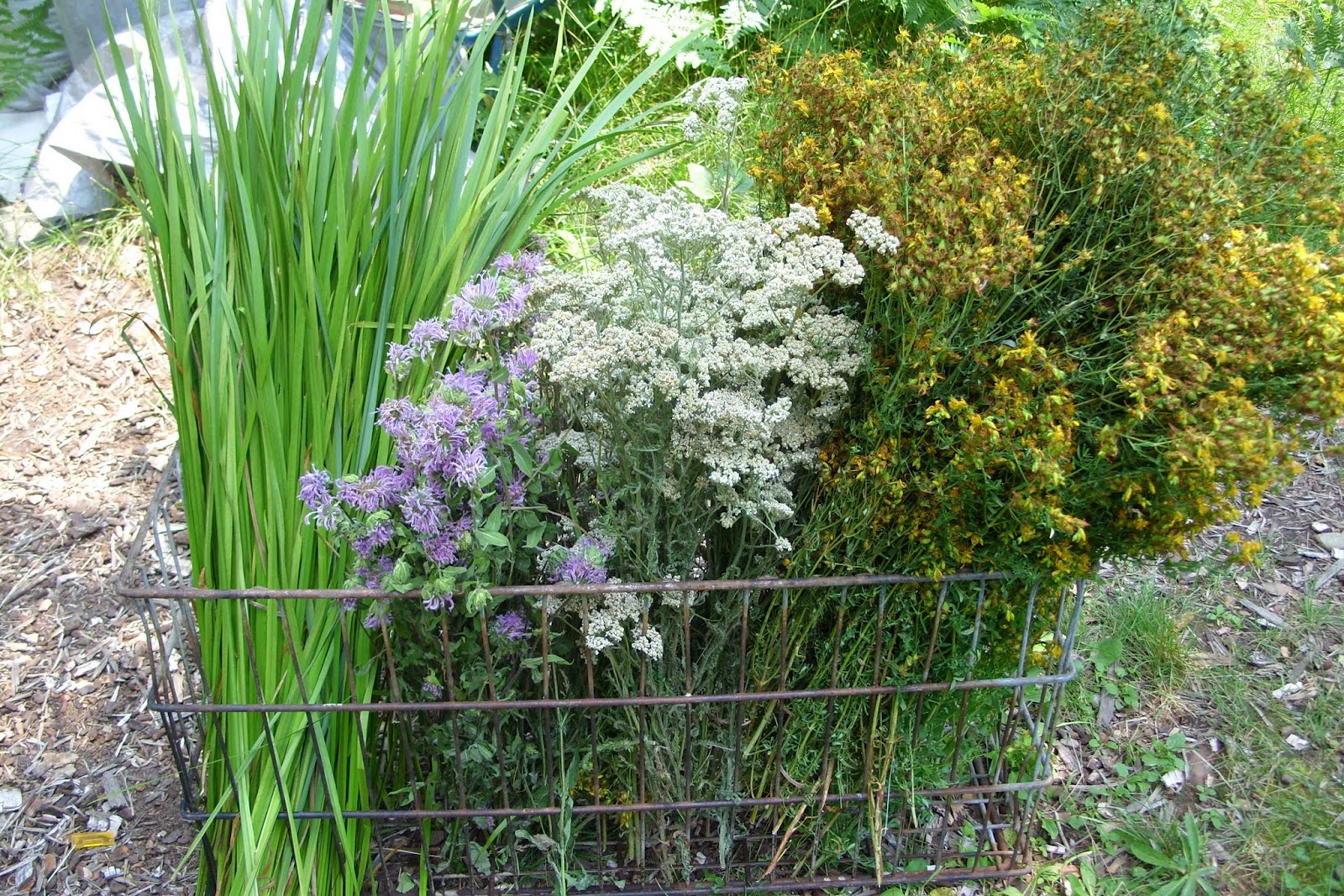
On our scouting expedition yesterday we were intent on picking linden flowers. Linden, A.K.A., basswood, are large trees so in order to pick their flowers you have to find young smaller trees that are blooming. Usually the ones on the edge of a wood where they get more sun bloom young. We know of just such a spot but no luck, or not much luck anyway. The big mature trees have lots of blossoms but the smaller bushy trees that we can reach were almost devoid of blooms.Oh well, that is the way of foraging. We did harvested these medicinal and tea plants however. Left to right, sweet flag, wild bergamot, yarrow, and st. johns wort. As for the scouting part we were checking out several areas where we harvest wild rice. Right now it looks like a decent crop but that can change of course. We saw lots of hazel nuts and nanny berries but no black cherries. Red oaks look like they will have a moderate crop of acorns this year.
We needed a much larger dehydrator to hold some of the plant material we harvest. This year I started building the beast pictured. All very low tec, use what ya got, sort of contraption.Big pallet with a crate attached forms the base. Then I added a frame to hold a piece of sheet metal. This was painted flat black and then covered with some surplus storm windows.Warm air rises and enters the crate, as it cools it settles and is pulled back into the heat exchanger area. Couple of bars in the crate let us hand plants in the box to dry. I will be adding some cleats to hold trays which I have to build yet. With on and off sunshine and a slight haze temps in the middle of the crate were hovering around 120 F.I have two small solar panels I am going to add to power a small vent fan . I have to make a actual door instead of the piece of plywood leaning against it and caulk a few joints which should let it reach a little higher temps. I'm shooting for 130-140F. which will let us dehydrate veggies and some fruit too.
On a side note, this is post #101!
( What do you think Wilma?)
On a side note, this is post #101!
( What do you think Wilma?)
Tuesday, July 3, 2012
Heal-All
Here is a great medicinal plant I am going to gather today. It is Heal-All,Self-Heal, Prunella vulgaris.
It is a perennial of the mint family which is indicated by it's weakly square stem and the shape of it's flowers. Research shows it contains ursolic acid which is a antitumor compound. Some research suggest it possesses antibiotic ,and hypotensive properties.One traditional use that I like is using a leaf tea as a gargle for sore throats and mouth sores. It is used in traditional Chinese medicine also. Used in reasonable amounts, there does not seem to be any toxicity issues. As always do not use any plant you can not 100% positively identify, and of course, this is a description of traditional uses and not medical advice!
On a different note, here is a view of our main garden. Every thing is doing fairly well but the insects are out in huge numbers this year. I have been dusting with diatomaceous earth ( DE ) on a regular basis. It has been dry enough that slugs are not to bad. They can be problematic with deep mulch during a wet year. The deep mulch is great weed control and most of the garden is fairly weed free. I actually am leaving some weeds grow, both as bait a crop for the bad bugs but also as habitat for good bugs. I don't let the weeds go to seed but being totally weed free in a organic setting is not practical nor desirable. Besides, a lot of those "weeds" are great food!
It is a perennial of the mint family which is indicated by it's weakly square stem and the shape of it's flowers. Research shows it contains ursolic acid which is a antitumor compound. Some research suggest it possesses antibiotic ,and hypotensive properties.One traditional use that I like is using a leaf tea as a gargle for sore throats and mouth sores. It is used in traditional Chinese medicine also. Used in reasonable amounts, there does not seem to be any toxicity issues. As always do not use any plant you can not 100% positively identify, and of course, this is a description of traditional uses and not medical advice!
On a different note, here is a view of our main garden. Every thing is doing fairly well but the insects are out in huge numbers this year. I have been dusting with diatomaceous earth ( DE ) on a regular basis. It has been dry enough that slugs are not to bad. They can be problematic with deep mulch during a wet year. The deep mulch is great weed control and most of the garden is fairly weed free. I actually am leaving some weeds grow, both as bait a crop for the bad bugs but also as habitat for good bugs. I don't let the weeds go to seed but being totally weed free in a organic setting is not practical nor desirable. Besides, a lot of those "weeds" are great food!
Monday, July 2, 2012
Suckering Tomatoes
If you live in an area with a growing season that just manages to provide 90 frost free days like I do, removing suckers on your tomato plants is a worth while task. It is especially helpful on some of the old open pollinated indeterminate varieties. They seem to put on suckers as fast as you can pinch them off but pinching them off forces the plant to put it's energy into maturing the fruit already on the plant instead of growing more shoots.A sucker is the shoot that grows out of the junction of a limb and the main stalk like the one my knife blade is resting on. I just pinch it off with my fingers. I also like to stake my tomatoes rather than using cages. I tie them up with stripes ripped from old tee shirts. I tie the strip to the stake and then make a loose loop around the main stalk of the plant.
Here on the left is a recent pic in the high tunnel. I have the stakes fastened to the frame of the tunnel so they can easily support the tomato plants. So far they seem to like the extra heat they are getting although if this heat wave continues it won't matter. We have had to start watering the garden and new trees and shrubs again. It is hovering around the 90 degree mark which is nice compared to what much of the country is getting but still enough to make plants suffer quickly without enough rain.
The pic to the right is interesting because of those bees lined up with their butts in the air on the right edge of the landing board. They are on fan duty, moving air into the hive to help cool it. Notice how the rows alternate spacing to maximize the effect. Amazing creatures!
Subscribe to:
Posts (Atom)